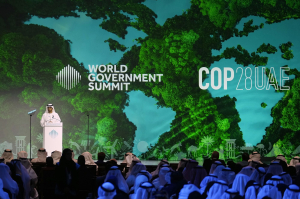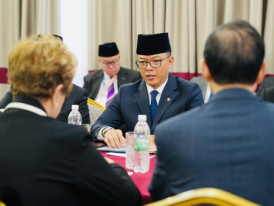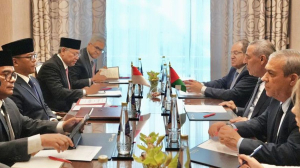



The success of the global push to triple renewable energy by 2030, as agreed at COP28, heavily depends on energy transition efforts by Indonesia and fellow BRICS nations, said a new report by the Net Zero Policy Lab (NZPL) at Johns Hopkins University.
It suggests that a failure to accelerate clean energy transitions within BRICS could derail global climate goals and bring economic risks to member countries.
The report, titled “BRICS Going Green,” highlights that the BRICS bloc − comprising Brazil, Russia, India, China, South Africa, Egypt, Ethiopia, Indonesia, Iran, and the United Arab Emirates − accounts for over half of global carbon emissions. While clean energy investment has overtaken fossil fuels in the bloc, largely driven by Brazil, China, and India, internal disputes over transition policies persist and overall green investment still falls short of what is needed to meet the Paris Agreement goals.
“Why are BRICS countries adopting green industrial policies? One reason is these policies enable them to capture economic value, jobs, and productivity from rapidly growing sectors − or risk being left behind. The International Energy Agency estimates that clean technologies contributed around 10 percent of global GDP growth last year,” Kritika Kapoor, a researcher at the Net Zero Policy Lab, said in a statement on Thursday, July 17, 2025.
For Indonesia specifically, the report notes major strides in green manufacturing. In June 2025, Indonesia signed a US$10 billion green industrial zone deal with Singapore, targeting solar panels and battery production in Bintan, Batam, and Karimun. Indonesia, as the world’s largest nickel downstreaming hub, also announced plans to build a 150 GWh-per-year electric vehicle battery plant.
However, Indonesia’s green transition remains in question. The 2024 National Electricity Plan still includes roughly 60 percent reliance on coal, despite the country’s pledge to phase it out and target 75 GW of renewable energy capacity by 2040. Moreover, the report warns that limited investment in R&D, patents, and education could weaken Indonesia’s long-term prospects for green industrialization.
To ensure a just and inclusive global transition, the report urges BRICS nations to go beyond fuel substitution and take proactive leadership in shaping a new international order while upholding inclusive multilateralism. It outlines three key policy agendas for BRICS: industrial and technological cooperation, investment and financing collaboration, and inclusive multilateral governance.
For Indonesia, specific recommendations include reforming biofuel supply chains to capitalize on its vast agricultural resources. This involves setting policies for land use and conversion pathways to prevent deforestation and biodiversity loss. On the downstream side, mandates for biofuel blending and certification must be established, along with alignment of financial, trade, and technological tools to support biofuel adoption.
Already have an account? Sign In
-
Start reading
Freemium
-
Monthly Subscription
20% OFF$29.75
$37.19/MonthCancel anytime
This offer is open to all new subscribers!
Subscribe now -
Yearly Subscription
33% OFF$228.13
$340.5/YearCancel anytime
This offer is open to all new subscribers!
Subscribe now
Set up email notifications for these topics