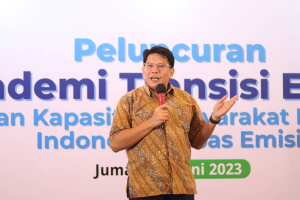



The Institute for Essential Services Reform (IESR) has raised concerns over Southeast Asia’s transition to clean energy, citing the absence of concrete national targets and complex bureaucracy as major obstacles.
Arief Rosadi, Climate and Energy Diplomacy Program Manager at IESR, said ASEAN has set an aspirational goal to raise the share of renewable energy to 23 percent of its total primary energy supply by 2025 as outlined in the ASEAN Plan of Action for Energy Cooperation (APAEC) 2021–2025.
“However, this target lacks specific allocation. For instance, there’s no breakdown of how much Indonesia, Vietnam, or Thailand must contribute. So, the nature of the target remains very loose,” Arief said as quoted by Antara in Jakarta on Tuesday, July 8, 2025.
He pointed to Vietnam’s aggressive development of renewable energy, adding 18–24 gigawatts in recent years, as an example of individual progress that could potentially help meet ASEAN’s overall target. Nevertheless, he stressed that contributions from other ASEAN countries remain unclear, given the wide disparities in energy transition progress across the region.
Despite issuing joint statements to the UN Climate Change Conferences (COPs), Arief noted that ASEAN's declarations are often normative rather than binding. Furthermore, the bloc lacks a unified target, is not part of a strong negotiation bloc, and its role in global climate negotiations remains limited.
Another key challenge, according to Arief, is ASEAN’s strong adherence to the principle of non-interference. This principle discourages member states from imposing obligations on one another, making coordinated progress on energy transition even more difficult.
ASEAN’s current energy roadmap, APAEC 2021–2025, focuses on promoting a cleaner, more efficient, and sustainable energy future through seven strategic programs: the ASEAN Power Grid, Trans-ASEAN Gas Pipeline, Clean Coal Technology, Energy Efficiency and Conservation, Renewable Energy, Regional Energy Policy and Planning, and Civilian Nuclear Energy.
“Looking at the current structure of regional energy planning, it’s still far from a true commitment to energy transition,” Arief said. He suggested that the five-year planning framework should be revisited and adjusted to align with current challenges and needs.
The IESR’s remarks highlight the pressing need for more decisive action, clearer national commitments, and greater regional coordination if ASEAN hopes to achieve its clean energy ambitions.
Already have an account? Sign In
-
Start reading
Freemium
-
Monthly Subscription
20% OFF$29.75
$37.19/MonthCancel anytime
This offer is open to all new subscribers!
Subscribe now -
Yearly Subscription
33% OFF$228.13
$340.5/YearCancel anytime
This offer is open to all new subscribers!
Subscribe now
Set up email notifications for these topics