


Indonesia holds substantial potential for implementing carbon capture and storage (CCS) and carbon capture, utilization, and storage (CCUS) technologies, especially in terms of its carbon storage capacity, says Diofanny Swandrina Putri, Director of the Indonesia and Regional CCS Strategic Initiative at the Indonesia CCS Center.
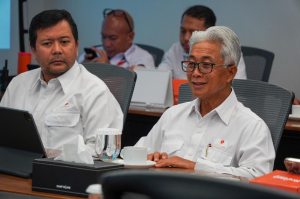
Speaking during a panel discussion titled “Integrating Carbon Capture Storage/Carbon Utilization Storage”, part of the National Forum on Upstream Oil and Gas Sustainability held on Tuesday, July 8, 2025, Diofanny said that while Indonesia may not be in the global top five, it leads in Asia.
“Globally, Indonesia is not in the top five, but in Asia, we rank first. We have a carbon storage potential of 80 to 600 gigatons,” she said.
This large potential is supported by the presence of two geological layers suitable for carbon storage, positioning Indonesia well to begin scaling CCS/CCUS activities. Diofanny estimated that optimal use of CCS/CCUS could help reduce Indonesia's carbon emissions by up to 17 percent by 2060, as part of broader emission reduction initiatives.
However, she acknowledged that tapping this potential comes with significant challenges − a sentiment echoed by fellow panelist Adam Sheridan, Chief of Insight, Strategy and Execution at the Upstream Oil and as Regulatory Task Force (SKK Migas).
“600 gigatons is an amazing starting point, but the challenges are real. It's not just about the subsurface − there’s also the issue of buyers in the carbon market,” Sheridan said.
He added that Indonesia currently has 14 CCS/CCUS-related activities, but none have yet reached commercial scale due to economic and regulatory hurdles. For smaller projects, standalone CCS/CCUS ventures are not yet economically viable, he noted.
Another major hurdle is regulatory uncertainty, highlighted by Haruki Agustina, Director of Climate Change Mitigation at the Ministry of Environment and Forestry (KLHK).
“There are no clear regulations on permitting for CCS/CCUS yet. We need proper studies and impact assessments before we can issue any licenses,” Haruki said.
Despite the regulatory and economic obstacles, all three experts agreed that CCS/CCUS remains a crucial tool for achieving Indonesia’s climate goals, including its Net Zero Emissions (NZE) target by 2060 and a 29 percent emissions reduction by 2030 as committed in its Nationally Determined Contribution (NDC).
The development of CCS/CCUS could also extend the life of Indonesia’s oil and gas production and generate new economic opportunities through carbon trading, provided a conducive ecosystem and investment framework is established.
Already have an account? Sign In
-
Start reading
Freemium
-
Monthly Subscription
20% OFF$29.75
$37.19/MonthCancel anytime
This offer is open to all new subscribers!
Subscribe now -
Yearly Subscription
33% OFF$228.13
$340.5/YearCancel anytime
This offer is open to all new subscribers!
Subscribe now
Set up email notifications for these topics