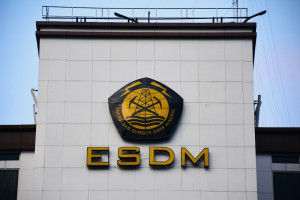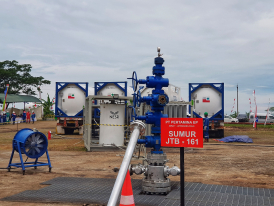



The Ministry of Energy and Mineral Resources (ESDM) has issued a new regulation to legalize and regulate community-run oil wells − previously categorized as illegal − as part of the government’s broader strategy to boost national oil production and enhance environmental and operational safety standards.
The regulation, outlined in ESDM Ministerial Regulation (Permen) No. 14/2025 on Cooperation in Managing Oil and Gas Working Areas for Production Enhancement, mandates that community wells will now be managed through regional-owned enterprises (ROEs); cooperatives; and micro, small, and medium enterprises (MSMEs).
Deputy ESDM Minister, Yuliot Tanjung, said the regulation aims to reduce environmental degradation, address safety concerns, and improve the state’s oil lifting performance and revenue.
“This aligns with our national target of reaching 1 million barrels per day (bpd) by 2029–2030. With current production ranging between 580,000 and 600,000 bpd, we still need to add around 400,000 bpd,” Yuliot told a press conference on Tuesday, July 1, 2025.
The new framework recognizes the economic role of community wells, which, according to ministry data, could contribute at least 10,000 bpd in additional lifting. Many of these wells have long been operated informally by local communities and are often a primary source of income.
“In some areas, up to 20 percent of residents depend on these wells for their livelihood,” Yuliot said. “This regulation is designed to ensure those activities continue in a more sustainable and regulated manner.”
Under the transitional four-year period, existing wells will be allowed to operate while undergoing improvements in line with good engineering practices. During this period, communities are encouraged to form legal entities such as cooperatives or MSMEs with local residents as shareholders.
Mechanism
Crude oil produced under this scheme must be sold to existing oil contractors (KKKS) with Production Sharing Contract (PSC) status. The revenue split is defined at 80 percent of the Indonesian Crude Price (ICP) for the community entity, while 20 percent goes to the KKKS for processing and operations.
“The community benefits directly from oil revenue, while KKKS provides oversight and technical guidance,” Yuliot cited.
However, authorities stressed that no new wells can be established under the community scheme. Unauthorized drilling will trigger enforcement by the Directorate General of Law Enforcement (Ditjen Gakkum).
The regulation mandates the formation of a joint verification team to inventory community wells. The team will include representatives from local governments, Upstream Oil and Gas Regulatory Task Force (SKK Migas), Aceh Oil and Gas Management Agency (BPMA) if the work area is in Aceh province, and PSC contractors.
Governors, based on district-level recommendations, will appoint one ROE, cooperative, or MSME per region to manage the wells. The selected entity will then propose a partnership with a KKKS, which must be approved by the ESDM minister via SKK Migas or BPMA.
The government also plans to form an inter-ministerial task force including the Ministry of Cooperatives and SMEs and the Ministry of Home Affairs to support capacity-building efforts for local business entities.
Oil contractors companies may also serve as technical mentors to community operators, regardless of whether they fall within the same oil and gas working area.
Legalization of old practices
The government sees the initiative as a continuation of earlier efforts. Since 2008, approximately 1,400 old wells, primarily in Central and East Java, South Sumatra, and Jambi, have been incorporated into legal operations, producing around 1,600 bpd.
Yuliot emphasized that while community operations will be allowed to continue, regulatory compliance is critical.
“Should there be no improvement after four years, the government will enforce legal measures either by helping complete their licensing or by halting operations,” he said.
By formalizing these operations, the government hopes to turn a longstanding informal practice into a structured, legally compliant sector that contributes to both national energy output and local economies.
“This is not just about oil. It’s about protecting people’s livelihoods while ensuring the state’s energy resilience,” Yuliot said.
Already have an account? Sign In
-
Start reading
Freemium
-
Monthly Subscription
20% OFF$29.75
$37.19/MonthCancel anytime
This offer is open to all new subscribers!
Subscribe now -
Yearly Subscription
33% OFF$228.13
$340.5/YearCancel anytime
This offer is open to all new subscribers!
Subscribe now
Set up email notifications for these topics