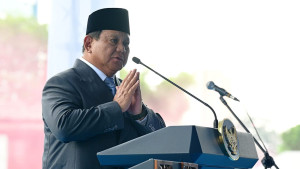



President Prabowo Subianto has reaffirmed his administration’s commitment to achieving national energy independence by developing a large-scale, integrated electric vehicle (EV) battery industry ecosystem, emphasizing the need for Indonesia to reach a production capacity of 100 gigawatts (GW) to realize his vision of energy self-sufficiency.
“The report stated a production of 15 GW, but experts told me that to be truly independent, we may need 100 GW. That means this project must be scaled up,” President Prabowo said at the inauguration of the EV battery industry project in the Artha Industrial Hills (AIH) area in Karawang, West Java, on Sunday, June 29, 2025.
Prabowo described the inauguration as clear evidence of the government's seriousness and its strategic partners’ commitment to building a fully integrated battery industry, from upstream to downstream.
He characterized the project as a major leap toward national energy sovereignty, with Indonesia aiming to produce eco-friendly, renewable energy-based batteries, in line with global goals for a green industrial future.
“In five years − six years at the latest − we will achieve energy independence. One of the main paths is solar power, and the key lies in battery technology,” he added.
The Karawang integrated EV battery project is expected to produce 5.9 gigawatt hours (GWh) of batteries annually by 2026, ramping up to 15 GWh per year by 2028 when fully operational. It is designated as a National Strategic Project (PSN) with a total investment of US$5.9 billion (Rp96 trillion).
This ecosystem is a collaboration between PT Aneka Tambang (Antam), Indonesia Battery Corporation (IBC), and an international consortium consisting of Contemporary Amperex Technology Co. Limited (CATL), Brunp, and Lygend (CBL).
Of the six projects within this ecosystem, five are located in East Halmahera, North Maluku, with a combined investment of US$4.7 billion, while the Karawang project accounts for US$1.2 billion. Covering a total of 3,023 hectares (ha), the entire ecosystem is projected to directly employ around 8,000 workers and stimulate regional economic growth.
The ecosystem also includes 18 supporting infrastructure projects. In terms of energy sources, the FHT zone will rely on a hybrid power system, including coal (2×150 MW), gas turbines (80 MW), waste heat recovery (30 MW), and solar power (172 MWp). Meanwhile, the Karawang plant will utilize 24 MWp of solar energy to support sustainable industrial operations.
Already have an account? Sign In
-
Start reading
Freemium
-
Monthly Subscription
20% OFF$29.75
$37.19/MonthCancel anytime
This offer is open to all new subscribers!
Subscribe now -
Yearly Subscription
33% OFF$228.13
$340.5/YearCancel anytime
This offer is open to all new subscribers!
Subscribe now
Set up email notifications for these topics