


President Prabowo Subianto’s plan to construct a 500-kilometer-long Giant Sea Wall along Java’s northern coast − intended to mitigate the devastating effects of tidal flooding (banjir rob) − has sparked heated debate across the country, with environmentalists, coastal communities, and urban planners arguing the wall could do more harm than good.
The project, projected to cost around US$80 billion (Rp1,298 trillion) and take 15 to 20 years to complete, is a continuation of the National Capital Integrated Coastal Development (NCICD) initiative started in 2014 in Jakarta. The government sees this expansion as critical to protecting 70 industrial zones, five special economic areas, and major transport infrastructure located along the northern coastline.
Critics, however, argue that the giant sea wall does not address the primary cause of coastal flooding: land subsidence.
“This is a false solution. It doesn’t fix the real problem, which is the sinking land. Instead, it creates new hardships for the people,” Erwin Suryana, Deputy Program Manager of the People’s Coalition for Fisheries Justice (KIARA), said on Monday, June 16, 2025.
Elisa Sutanudjaja, Director of the Rujak Center for Urban Studies, warned that in the long term, the sea wall could exacerbate flooding rather than prevent it.
“It blocks river mouths and bays, accelerates sedimentation, and slows water flow to the sea. The risk of urban flooding only increases,” she said.
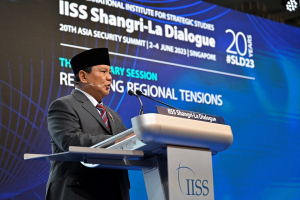
Previously, President Prabowo announced the immediate commencement of the mega project while addressing the International Infrastructure Conference in Jakarta on June 12, 2025.
“This initiative is vital and has been part of Bappenas (National Development Board) planning since 1995. There will be no more delays,” he said, citing that the sea wall would stretch from Banten to Gresik, East Java.
A recent survey by the Destructive Fishing Watch (DFW) found that 56.2 percent of the public oppose the plan, citing fears of environmental degradation and loss of livelihoods − particularly among fisherfolk.
“Many fishermen are already struggling. The NCICD project has forced them to sail further as their traditional routes were blocked. Now, catch sizes have shrunk dramatically,” Luthfian Haekal, a DFW researcher, said.
The construction, which includes large-scale dredging, has reportedly led to sediment covering coral reefs − vital habitats for marine life.
“Without coral reefs, fish won’t breed. Without fish, there’s nothing to catch,” Erwin said.
A 2016 study by the Ministry of Marine Affairs and Fisheries reveals that Jakarta’s NCICD project alone causes tens of billions of rupiah in losses for local fishers each year. Expanding the project to East Java could multiply those losses.
Hardiyanto Kenneth, a member of the Jakarta Provincial Legislative Council, recites incidents where seawalls breached and flooded neighborhoods. Many of them have collapsed, instead of preventing floods, they ended up causing them.
Elisa emphasized that infrastructure like the GSW is considered maladaptive if it ignores the underlying issues. The IPCC’s 2022 report cited Jakarta’s sea wall as an example of an adaptation project that ended up increasing flood risks for vulnerable urban populations.
“Unless we fix the cause − over-extraction of groundwater by heavy industries − the wall will sink or crack. That’s exactly what happened in Muara Baru in 2019,” Elisa said.
The economic narrative used to justify the wall also raises eyebrows. Coordinating Minister for the Economy, Airlangga Hartarto, said the northern Java coast is vital, contributing 20 percent of Indonesia’s GDP. With a population of 50 million, any disruption could be catastrophic.
Experts, however, argue this logic overlooks the root of the problem. Ciko Tricanesco, a water resources official in Jakarta said heavy industry and port operations along the coast are causing the land to sink. Instead of dealing with that, the government even plans to build a wall to protect re coastal regions.
The Indonesian Forum for the Environment (Walhi) asked the government to revoke industrial permits along the coast, calling it the only way to stop land subsidence.
Some researchers believe the project may offer only temporary relief while inviting greater disaster. Elisabeth Augustina Issantyarni, a coastal geographer, described the project as paradoxical.
“The wall creates a false sense of security, which in turn attracts more development. That added weight accelerates subsidence and sets the stage for even worse floods. It’s only a matter of time,” she said.
She emphasized that alluvial soil in coastal areas is fragile and cannot support heavy infrastructure without sinking. “What seems like protection today could result in much bigger losses when disaster strikes in the future,” she cited.
Despite widespread criticism, the government shows no sign of backing down. The giant sea wall is now officially part of the National Medium-Term Development Plan (RPJMN) 2025–2029. With Jakarta as priority, followed by Semarang, Pekalongan and Brebes.
Already have an account? Sign In
-
Start reading
Freemium
-
Monthly Subscription
20% OFF$29.75
$37.19/MonthCancel anytime
This offer is open to all new subscribers!
Subscribe now -
Yearly Subscription
33% OFF$228.13
$340.5/YearCancel anytime
This offer is open to all new subscribers!
Subscribe now
Set up email notifications for these topics