


The Ministry of Energy and Mineral Resources (ESDM) is considering the deployment of floating nuclear power plants (PLTN) to electrify remote areas in Eastern Indonesia, which currently rely heavily on oil-fueled power generators.
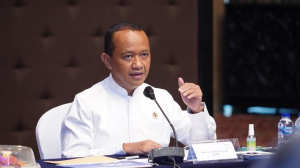
“The government is also considering the use of floating nuclear power plants for remote areas in Eastern Indonesia,” Jisman P. Hutajulu, Director General of Electricity at the ESDM Ministry, said as quoted from the ministry’s official website on Thursday, May 22, 2025.
Jisman cited that several key strategic energy documents have been finalized, including the National Energy Policy (KEN), approved by the House of Representatives (DPR), and the National Electricity General Plan (RUKN), officially issued by Minister Bahlil Lahadalia. He added that the Electricity Supply Business Plan (RUPTL) 2025–2034 is nearing completion and will soon be formalized by the ESDM ministry.
The draft RUPTL includes a plan for nuclear energy integration over the next decade, with a target capacity of 500 megawatts (MW). However, Jisman acknowledged that nuclear power development still faces significant challenges, particularly concerning safety concerns and public acceptance.
“We need to learn from countries like India and Bangladesh that have already developed nuclear power plants,” he added.
In support of these developments, the Nuclear Energy Regulatory Agency (BAPETEN) is currently revising the Nuclear Energy Law to strengthen legal and safety frameworks.
“We are updating Law No. 10/1997 on Nuclear Energy to include provisions on security, preparedness, international cooperation, and law enforcement,” Haendra Subekti, Deputy for Safety Assessment at BAPETEN, said.
The Indonesian government has also announced plans to build a 250 MW on-grid nuclear power facility, initially targeted for operation by 2032 but now being fast-tracked for completion by 2029.
This nuclear initiative forms part of Indonesia’s broader strategy to transition to new and renewable energy (NRE) sources. According to the National Electricity General Plan (RUKN) 2025–2060, the country’s total power capacity is projected to reach 443 gigawatts (GW) by 2060, with 79 percent coming from renewable sources.
The move underscores Indonesia’s growing commitment to clean energy and decarbonization, leveraging advanced technologies like nuclear to address geographic challenges and reduce dependency on fossil fuels in isolated regions.
Tag
Already have an account? Sign In
-
Start reading
Freemium
-
Monthly Subscription
20% OFF$29.75
$37.19/MonthCancel anytime
This offer is open to all new subscribers!
Subscribe now -
Yearly Subscription
33% OFF$228.13
$340.5/YearCancel anytime
This offer is open to all new subscribers!
Subscribe now
Set up email notifications for these topics