


The Ministry of Energy and Mineral Resources (ESDM) has continuosly disseminated the importance of developing Carbon Capture and Storage (CCS) technology in line with the global push to reduce CO2 emissions and the increasingly promising business opportunity and its considerable impact on the country’s economic growth
Ariana Soemanto, Director of Upstream Oil and Gas Business Development at the ESDM ministry, highlighted that upstream oil and gas investments have already required significant capital, even without the inclusion of CCS technology. With the global push to reduce emissions, the implementation of CCS is becoming inevitable.
“CCS requires substantial investment. The oil and gas sector has long supported economic growth through significant multiplier effects,” Ariana said during the Plenary Session CCS for Upstream Decarbonization and Beyond held at ICE BSD, Tangerang, Banten on Wednesday, May 21, 2025.
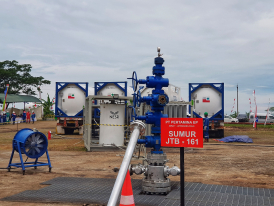
Currently, several CCS projects are underway in Indonesia. These include the Sukowati field project by Pertamina, the proposed Sunda Asri project by Pertamina and ExxonMobil, the Masela project led by Inpex Masela Ltd., the Sakakemang block managed by Repsol, and the Tangguh block operated by bp. Notably, the Tangguh project has already reached Final Investment Decision (FID), with an additional investment totaling US$7 billion.
Ariana also revealed that three standalone CCS projects have been proposed to the government. “Three stand-alone CCS projects have been submitted to us. We are awaiting direction from the (ESDM) Minister,” she said.
Meanwhile, Daniel Fletcher, Head of CCUS Business Development at bp, noted that Indonesia has strong potential to drive the CCS business forward, thanks to its favorable geological reservoir conditions and developing regulatory framework.
Indonesia has already issued Ministerial Regulation No. 2 of 2023 concerning the Implementation of Carbon Capture and Storage, as well as Carbon Capture, Utilization, and Storage (CCUS) in Upstream Oil and Gas Activities. This regulation governs the safe and permanent capture, transport, and storage of carbon emissions.
“The success of CCS projects depends on several factors. First, the quality of resources and reservoirs − and Indonesia has those. Second, regulation − and we see good progress. In 2024, bp even managed to realize CCS projects both in the UK and in Indonesia (Tangguh),” Daniel cited.
He expressed hope that the Indonesian government would soon issue additional regulations, particularly to enable cross-border carbon storage. With regulatory certainty, the CCS business ecosystem would naturally grow, including support from financial institutions.
“We hope CCS projects can support decarbonization. With the right government incentives and regulations, we could even trigger financial backing,” Daniel concluded.
Already have an account? Sign In
-
Start reading
Freemium
-
Monthly Subscription
20% OFF$29.75
$37.19/MonthCancel anytime
This offer is open to all new subscribers!
Subscribe now -
Yearly Subscription
33% OFF$228.13
$340.5/YearCancel anytime
This offer is open to all new subscribers!
Subscribe now
Set up email notifications for these topics