

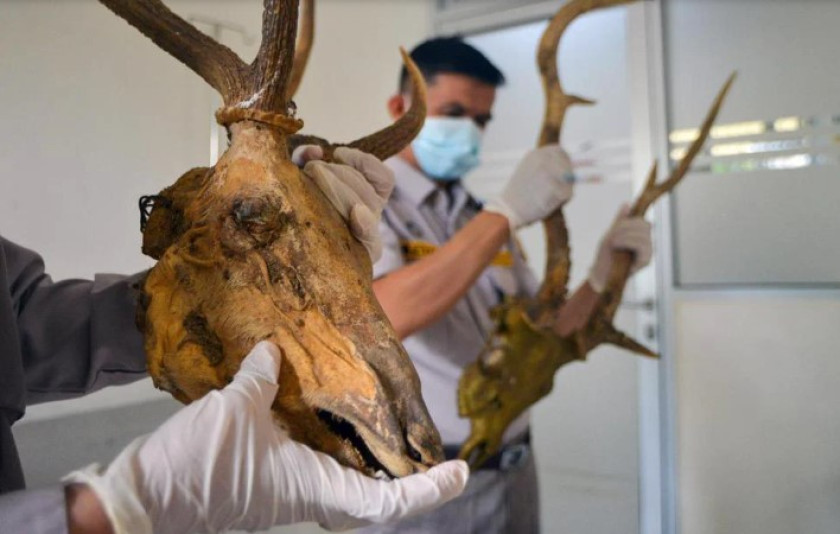
Satwa - image source: Antara Foto/ Iggoy Al Fitra
The Directorate General of Law Enforcement at the Ministry of Environment and Forestry is intensifying efforts to investigate illegal wildlife trade (TSL) in Indonesia, with a focus on its potential connection to money laundering crimes (TPPU).
Dwi Januanto Nugroho, Director General of Law Enforcement at the Ministry of Environment and Forestry, emphasized that wildlife trafficking is one of the world’s most lucrative criminal enterprises, ranking just below drug trafficking, arms smuggling, and human trafficking.
“Wildlife crime is closely linked to money laundering,” Dwi said on Thursday, May 15, 2025.
According to Dwi, his office will continue tracking wildlife traffickers in the field in order to uncover the main actors behind these illegal networks.
“We are starting with the field-level offenders and building up from there,” he said.
To support ongoing investigations, the Directorate General of Law Enforcement has formally reached out to provincial governments − specifically in North Sumatra, Manado, and East Java − which are known as key hubs in the country’s illegal wildlife trade routes.
“We’ve sent letters to the governors, especially in these areas, as they are major transit points for wildlife trafficking,” Dwi said.
Earlier this year, the Directorate General of Law Enforcement arrested two suspects from Sukabumi, West Java, for attempting to sell parts of protected wildlife species online to international buyers. The suspects, identified as BH (32), the owner, and NJ (23), the seller, were found in possession of a disturbing collection of wildlife remains:
● 70 primate skulls (including orangutans, macaques, and monkeys),
● 6 hornbill beaks,
● 2 bear skulls,
● 2 hog deer skulls,
● 8 bear claws,
● 2 shark teeth, and
● 4 civet skulls.
Dwi underscored that illegal hunting and trafficking of protected species is a transnational crime and is currently the fourth-largest black market industry globally, after narcotics, illegal firearms, and human trafficking.
To combat this, the Directorate General of Law Enforcement has established two specialized task forces:
● The Transnational Forestry and Wildlife Crimes Team, and
● The Money Laundering (TPPU) Task Force.
These teams are tasked with dismantling complex trafficking networks that extend beyond Indonesia’s borders.
The government has reiterated its commitment to strengthening law enforcement and collaborating with both domestic and international agencies, including the United States Fish and Wildlife Service (USFWS).
Tag
Already have an account? Sign In
-
Start reading
Freemium
-
Monthly Subscription
20% OFF$29.75
$37.19/MonthCancel anytime
This offer is open to all new subscribers!
Subscribe now -
Yearly Subscription
33% OFF$228.13
$340.5/YearCancel anytime
This offer is open to all new subscribers!
Subscribe now
Set up email notifications for these topics