



Indonesia Business Post
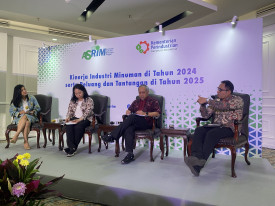
Amid relatively stable inflation, Indonesia’s declining purchasing power is being primarily driven by stagnating income levels, according to Mohammad Faisal, Executive Director of the Center of Reform on Economics (CORE) Indonesia.
Speaking about recent economic trends, Faisal emphasized that while inflation remains under control − hovering below 3 percent − the key issue lies in weakened income growth across working-class households, particularly those outside the formal employment sector.
“Although some goods have seen relatively high inflation, the national rate remains quite low. This indicates that the core issue of declining purchasing power lies more in income levels than in rising prices,” Faisal told Indonesia Business Post on Wednesday, May 14, 2025.
According to Faisal, middle-class and lower-income consumers are becoming more selective in their spending. Non-essential goods such as packaged beverages are seeing a decline in demand as households prioritize essential items, like rice and cooking oil.
“This shift in consumption behavior is especially evident among middle-income groups, who are the main target market for many consumer goods. When people are forced to choose between packaged drinks and basic necessities, the latter naturally take precedence,” he said.
Faisal underscored that limited growth in formal job creation has led to a rise in informal employment, where wages tend to be lower and more unstable. “While the open unemployment rate may have decreased, many of those affected by layoffs are now absorbed into informal sectors, which generally offer lower income and minimal security,” he added.
He called on policymakers to focus on both controlling the cost of living and raising household income through job creation. “We need stronger efforts to increase both the quantity and quality of employment. This means encouraging private sector investment, both new and existing, and maximizing government spending to support labor-intensive programs,” he cited.
Faisal further called for greater synergy across ministries, local governments, and state agencies to generate employment through infrastructure and public works projects, especially in rural and underserved areas.
The government is under pressure to maintain consumer confidence amid signs of softening domestic demand, especially in non-essential goods. With global economic uncertainties continuing to loom, experts say that boosting household income is critical to sustaining growth in Indonesian economy.
“Job creation should be a collective effort. Government budgets must be directed toward sectors that directly create jobs, while private companies should be incentivized to invest in labor-intensive industries,” he said.
Already have an account? Sign In
-
Start reading
Freemium
-
Monthly Subscription
20% OFF$29.75
$37.19/MonthCancel anytime
This offer is open to all new subscribers!
Subscribe now -
Yearly Subscription
33% OFF$228.13
$340.5/YearCancel anytime
This offer is open to all new subscribers!
Subscribe now
Set up email notifications for these topics