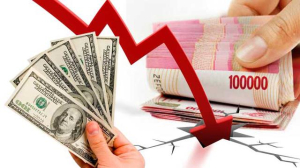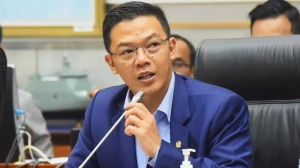



A senior economist, a diplomat and an industry player are confident that there is still room for Indonesia to maneuver amid global uncertainty and instability that have particularly been triggered by economic policies of U.S. President Donal J. Trump.
They shared their opinion during a public discussion themed "Trump effect: How Indonesia can seize opportunities amid a trade war" hosted by State radio broadcasting station RRI and the Gadjah Mada University Alumni Association in Jakarta on Wednesday, May 14, 2025.
Prominent economist and former Indonesian Central Bank (BI) Governor Soedradjad Djiwandono viewed Trump’s approach as “unique but dangerous,” highlighting the risks of unilateral decision-making by a global superpower.
“Trump often made crucial decisions half-asleep. Even his top economic advisor, Peter Navarro − a Harvard PhD − could not counter absurd moves like hiking import tariffs up to 140 percent,” Soedradjad said.
He emphasized that the world no longer operates under the dependencies of a century ago, but within a system of global interdependence. “In the global supply chain, one broken link can cripple the entire system,” he warned, pointing to the ripple effects of U.S. tariff hikes on countries like Canada, Mexico, and members of the European Union.
As for Indonesia, Soedradjad asked the nation to maintain a balanced relationship with major powers. “We must not align too closely with either the U.S. or China. Be like Singapore − friendly with everyone, but not looking for trouble,” he said.
He praised Indonesia’s increasingly active diplomacy, such as the recent economic delegation to Washington D.C. led by Coordinating Minister for the Economy Airlangga Hartarto. He also supported Indonesia’s economic outreach to BRICS nations, citing the ability to purchase Russian oil in rupiah as a strategic move.
“This is an extraordinary effort to preserve our foreign exchange reserves,” he noted.
Soedradjad advised Indonesia to remain agile amid global uncertainty. “Don’t be late. We must be flexible and ready to adapt if necessary. Unless necessary − just stay put,” he said.
Indonesian Ambassador to China, Djauhari Oratmangun, stressed the importance of maintaining strong relations with both the United States and China.
“Our trade with China has reached US$147.8 billion − far greater than with the United States (US$37 billion) or all of Western Europe (US$27 billion),” he cited.
Looking ahead, Djauhari expressed optimism about Indonesia’s role in a shifting global order, suggesting that the world may be moving toward a tripolar or continued bipolar power structure. He credited Indonesia’s active and strategic diplomacy − including President Prabowo’s close ties with President Xi Jinping − as a key factor in navigating the evolving geopolitical landscape.
Meanwhile, Toyota Motor Manufacturing Indonesia (TMMIN) President Director Nandi Julyanto emphasized the importance of strengthening domestic purchasing power to sustain Indonesia’s automotive industry amid global pressures, including U.S. President Donald Trump’s protectionist policies and the growing dominance of Chinese electric vehicles (EVs).
“We are not directly affected by President Trump’s policies, as the domestic market has remained stagnant over the past decade,” Nandi said.
“However, the real impact is indirect − affecting our export destinations such as ASEAN and Latin American countries. If their economies suffer, our exports decline,” he cited.
Nandi highlighted the vital role of government support in the form of incentives to stimulate demand. He recalled how automotive sales surged and state revenues increased during the pandemic when the government introduced vehicle tax breaks.
Regarding global supply chains, Toyota views the current shifts as an opportunity, particularly in the transition toward electrification.
“We aim to become part of the global supply chain for electrification, including building batteries in Indonesia in partnership with Chinese firms,” Nandi said.
He added that Toyota is targeting Indonesia to serve as a global hub for battery supply, electric drive units, and power control units (PCUs).
As electric vehicles now account for up to 50 percent of car ownership in major Chinese cities, like Shanghai, Indonesia could potentially see an influx of Chinese EVs diverted from Europe and the U.S., where high tariffs are in place.
While this could impact the domestic market, Nandi noted, the ultimate decision lies with consumers.
In response to these global shifts, Toyota is actively exploring new export markets and expanding its production capacity.
“In every crisis, there is an opportunity. We must be smart in identifying those opportunities and forging strategic partnerships,” he concluded.
Already have an account? Sign In
-
Start reading
Freemium
-
Monthly Subscription
20% OFF$29.75
$37.19/MonthCancel anytime
This offer is open to all new subscribers!
Subscribe now -
Yearly Subscription
33% OFF$228.13
$340.5/YearCancel anytime
This offer is open to all new subscribers!
Subscribe now
Set up email notifications for these topics