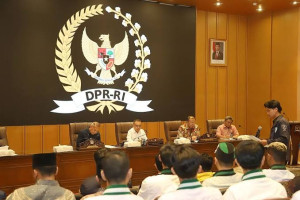


A Focus Group Discussion (FGD) was recently held in West Kalimantan under the theme “Accelerating Ecotourism and Sustainable Commodity Development through Social Forestry to Support Integrated Area Development (IAD),” co-organized by Katadata Green and Lingkar Temu Kabupaten Lestari (LTKL).
The FGD brought together key stakeholders involved in ecotourism and sustainable commodities within the Social Forestry program from four regencies: Kubu Raya, Sanggau, Sintang, and Kapuas Hulu. This event is part of a national FGD series, including similar discussions in Lima Puluh Kota (West Sumatra) and Buleleng (Bali).
“It’s important to translate national policies to the local level. One strategy is through the Integrated Area Development (IAD) framework,” Acting Head of Kubu Raya Regency’s Development Planning Agency, Herbimo Utoyo − known as Bimo − during the FGD held in Pontianak on Wednesday, April 30, 2025.
Bimo noted that IAD presents an opportunity for Kubu Raya to develop integrated ecotourism in its Social Forestry areas. However, unlike the other three regencies, Kubu Raya has yet to establish an IAD scheme. He emphasized that 70 percent of Kubu Raya’s villages are located within forest areas. The district has 30 villages with Village Forest Management Rights (HPHD) and one Community Plantation Forest (HTR), spread across six sub-districts, covering a total of 131,675 hectares.
Ya’ Suharnoto, Head of the Kubu Raya Forest Management Unit, highlighted that the district ranks second in West Kalimantan for the number of Social Forestry permits. He stressed that IAD offers a momentous opportunity for collaboration in developing ecotourism.
“In developing IAD, we must adopt a pentahelix model − engaging government, communities, businesses, academia, and media. We cannot work in silos,” he said.
According to Suharnoto, Presidential Regulation No. 28/2023 on Integrated Planning for Accelerated Social Forestry Implementation enables greater district-level involvement. Previously, forestry issues were largely under provincial jurisdiction, limiting local action.
He also shared local conservation strategies, including mangrove and peatland preservation − essential ecosystems for biodiversity. Another innovative approach is a “temporary closure” of river areas through a natural crab-saving strategy: communities are restricted from harvesting crabs temporarily to allow populations to regenerate before reopening for harvest.
Bimo added that the local government aims to consistently develop forest-based economic value, such as ecotourism and non-timber forest products. Collaboration, he said, is key − linking natural and human resources with downstream value chains through partn erships with local agencies, village organizations, and development partners.
Sharing experiences
The discussion also featured voices from other regencies. Marselus Yopos, head of the Adat Tae Social Forestry Group in Sanggau Regency, West Kalimantan, cited how his community integrates indigenous values into conservation.
“We apply the Tembawang concept to maintain forest cover while planting fruit-bearing trees,” Yopos said.
Tembawang refers to post-cultivation forests sustainably managed by the Dayak people for food, medicine, and daily needs. Key commodities include durian and sugar palm, which are processed into products such as durian cake and palm sugar for added economic value.
Yopos noted that the community divides the forest into two zones: a conservation zone where no activity is allowed, and a utilization zone where communities can harvest resources.
Similar strategies are also being implemented in Sintang and Kapuas Hulu regencies. In Sintang, the “rimba and gupung” forest management model is regulated by Regent Regulation No. 122/2021. Meanwhile, in Kapuas Hulu, community members in LPHD Bumi Lestari in Penepian Raya village conduct forest patrols three times a month to prevent degradation.
The FGD, attended by local government officials, civil society, private sector representatives, and academics, addressed challenges in implementing Social Forestry programs, including limited access, insufficient resources, and the need for stronger policy support.
To overcome these hurdles, the participants proposed developing an IAD plan for Kubu Raya. Through IAD, stakeholders can align their visions, strengthen collaboration, and synchronize policies between district and provincial governments for more effective forest-based development.
Already have an account? Sign In
-
Start reading
Freemium
-
Monthly Subscription
20% OFF$29.75
$37.19/MonthCancel anytime
This offer is open to all new subscribers!
Subscribe now -
Yearly Subscription
33% OFF$228.13
$340.5/YearCancel anytime
This offer is open to all new subscribers!
Subscribe now
Set up email notifications for these topics