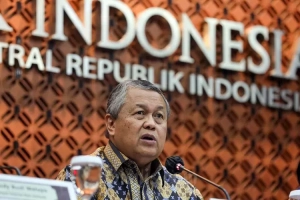



Governor of the Indonesian Central Bank (BI) Perry Warjiyo has called for a stronger role by the International Monetary Fund (IMF) in safeguarding global economic stability in the face of rising trade tensions and protectionist policies, particularly from major economies such as the United States.
Speaking at the IMF–World Bank Spring Meetings held in Washington DC on Sunday, April 27, 2025, Perry stressed that the IMF must be proactive in promoting open international trade systems to maintain global growth momentum.
"The IMF plays a strategic role in articulating a clear and firm stance, particularly in addressing collective challenges that threaten macroeconomic stability and the resilience of the global financial system," Perry said.
Representing the ASEAN region at the meeting, Perry emphasized the bloc’s collective commitment to a multilateral trading system that is open, inclusive, and rules-based.
He welcomed IMF’s guidance on boosting intra-regional trade, diversifying export markets, deepening capital market integration, and implementing structural reforms to stimulate domestic demand.
Perry also voiced BI’s support for the IMF’s efforts to enhance systemic and sustained economic surveillance through the Integrated Policy Framework (IPF), stressing the need to respect country-specific conditions.
He underscored the importance of strengthening the global financial safety net through greater collaboration with regional mechanisms, such as the Chiang Mai Initiative Multilateralization (CMIM) and advancing IMF quota reforms to reinforce the institution’s financial capacity.
Indonesian Minister of Finance, Sri Mulyani Indrawati, who was also present at the Spring Meetings, said the forum provided a crucial opportunity for member countries to engage in dialogue and ease tensions triggered by the United States’ recent tariff actions.
"This meeting gives countries the chance to exchange perspectives on how to approach the U.S. on tariffs, with the aim of reaching a comprehensive and sustainable solution that will bring global certainty," Sri Mulyani told a virtual press conference on Friday, April 26, 2025.
Economic outlook
The IMF downgraded its forecast for Indonesia’s economic growth to 4.7 percent for both 2025 and 2026, compared with a January estimate of 5.1 percent. The revision, outlined in the Fund’s April edition of the World Economic Outlook, reflects mounting concerns over the impact of new and retaliatory U.S. tariffs on global trade flows.
"Emerging Asian economies, particularly those in ASEAN, are among the most affected by the U.S. tariff increases," the IMF said in its report, warning of a broader drag on regional and global economic prospects.
The IMF now projects growth for emerging Asia at 4.6 percent in 2025 and 2026, slightly below earlier estimates. Global economic growth is forecast to slow to 2.8 percent in 2025, down from 3.3 percent projected earlier this year.
Economists warn that the growing wave of protectionism could further strain global supply chains, already under pressure from geopolitical conflicts and shifting manufacturing bases.
"Escalating trade tensions not only dampen trade volumes, but also create uncertainty that weakens investment and productivity growth," Julian Evans-Pritchard, Head of China Economics at Capital Economics, said in a note to clients.
Indonesia’s resilience
Despite external pressures, Indonesian policymakers expressed confidence in the country's economic fundamentals. Perry Warjiyo highlighted Indonesia’s efforts to strengthen domestic demand, deepen financial markets, and diversify its export base as buffers against external shocks.
Sri Mulyani also reaffirmed the government’s commitment to maintaining a prudent fiscal policy and continuing structural reforms to bolster competitiveness.
"Indonesia remains resilient, but global cooperation is needed to ensure that emerging markets are not disproportionately affected by the spillover effects of trade conflicts," she said.
Already have an account? Sign In
-
Start reading
Freemium
-
Monthly Subscription
20% OFF$29.75
$37.19/MonthCancel anytime
This offer is open to all new subscribers!
Subscribe now -
Yearly Subscription
33% OFF$228.13
$340.5/YearCancel anytime
This offer is open to all new subscribers!
Subscribe now
Set up email notifications for these topics